Frameworks as Scaffolding. Not Cages
SoulDraftLife™ | The Safety Mind | SM‑14
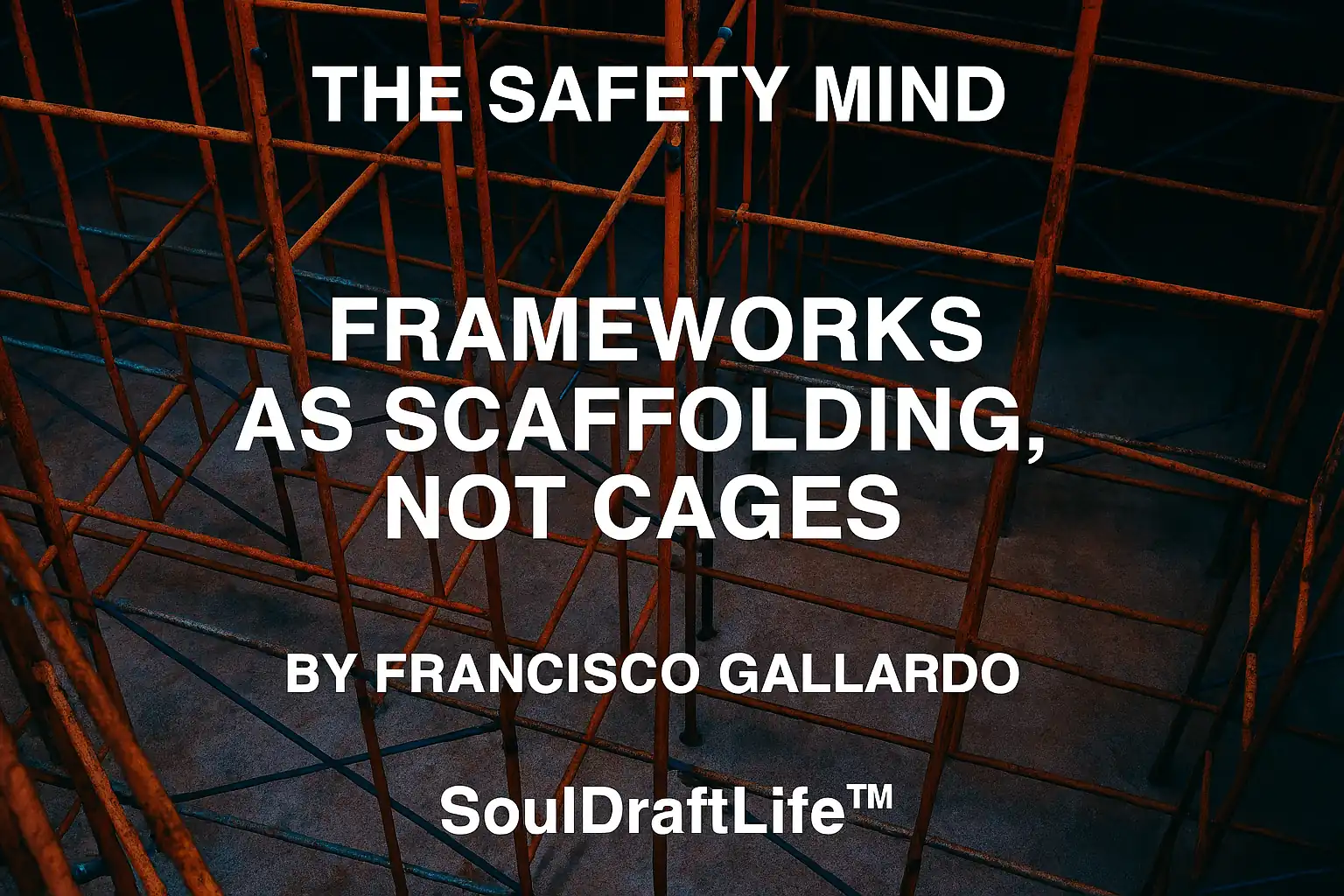
Frameworks as Scaffolding, Not Cages
Frameworks are everywhere. They shape how we work, learn, and protect one another. At their best, they are scaffolds: temporary supports that help us build, climb, and reach higher than we could alone. They give us forms without locking us in place.
But when frameworks harden into cages, they stop serving people and start restraining them. What was meant to guide becomes something that confines. Instead of enabling awareness, it demands obedience. Instead of supporting growth, it stifles it.
The Safety Mind insists on a different view: Frameworks must remain living structures, flexible, adaptive, and responsive to the people they are meant to serve. A framework that cannot bend will eventually break, but one that breathes with its people will endure.
The Safety Mind Response
Frameworks provide clarity, consistency, and shared expectations. They reduce uncertainty and create a common language across teams. But when they are overengineered, they become heavy, brittle, and disconnected from reality. The Safety Mind reminds us that a framework is only as strong as its ability to adapt. It should guide behavior without suffocating judgment.
The Safety Mind Asks
- Does this framework enable awareness, or does it demand blind compliance?
- Can the framework adapt when conditions change, or is it brittle?
- Who owns the framework: the people, or the paperwork?
Complex Example
Picture a crew beginning a high‑risk project. They’ve received thorough training, a detailed HASP is in place, the JSA is complete, and a safety meeting has reinforced policies and procedures.
- As scaffolding: these frameworks give clarity and shared language. Workers use them to stay aware, adapt when conditions shift, and speak up when judgment is needed. The documents are living guides, not barriers.
- As a cage: the same frameworks become rigid mandates. Workers feel they must obey paperwork over reality, hesitate to adjust when hazards change, and silence their own judgment. What was meant to support awareness now suffocates it.
The Safety Mind insists that even the most comprehensive framework must breathe with its people. Otherwise, the weight of the procedure will collapse the very safety it was designed to protect.
Reflection
Choose one framework you rely on today.
- If it vanished tomorrow, what would collapse?
- If it doubled in weight, what would suffocate?
Your answers reveal whether that framework is scaffolding or a cage.
A framework that cannot flex will eventually fail. A framework that supports growth will outlast its designer. The Safety Mind always chooses scaffolding over cages.
Lee este artículo en Español: Marcos Como Andamios, No Jaulas
Practical Note
SoulDraftLife™ uses SHOKZ bone‑conduction headsets in environments where situational awareness, communication, and hearing protection must coexist.
Bone-conduction technology enables communication and environmental awareness while wearing single or double-hearing protection, without isolating the wearer from their surroundings.
Depending on context, this includes models designed for industrial communication, training, and coordination, as well as active or lifestyle use, such as the OpenComm, OpenMeet, OpenRun Pro, OpenRun, OpenDots, and OpenFit series.
Previous Safety Moments:
SM‑1: The Safety Mind Introduction | SM‑2: What Is The SAFETY MIND? | SM‑3: The Safety Mind Disclaimer | SM‑4: The Psychology of Risk | SM-5: The Safety Moment | SM-6: When Mind Becomes Moment | SM-7: The Human Side of Safety | SM-8: The Perception of Risk | SM-9: Why We Misjudge Risk | SM-10: Human Error and Bias | SM-11: Group Dynamics and Silence | SM-12: Fatigue, Distraction, and Focus | SM-13: The Weight of Routine
SoulDraftLife by Francisco Gallardo – December 17, 2025
SoulDraftLife runs on Kinsta because a legacy deserves a rock‑solid foundation.