Human Error and Bias
SoulDraftLife™ | The Safety Mind | SM‑10
Human Error and Bias
Error Is Human
We like to imagine that mistakes are rare, the outliers in an otherwise smooth system. But mistakes are not rare. They are constant, woven into every action we take. The hand slips, the memory falters, the plan itself is flawed. These are not signs of weakness; they are signs of being human.
When Error Turns Invisible
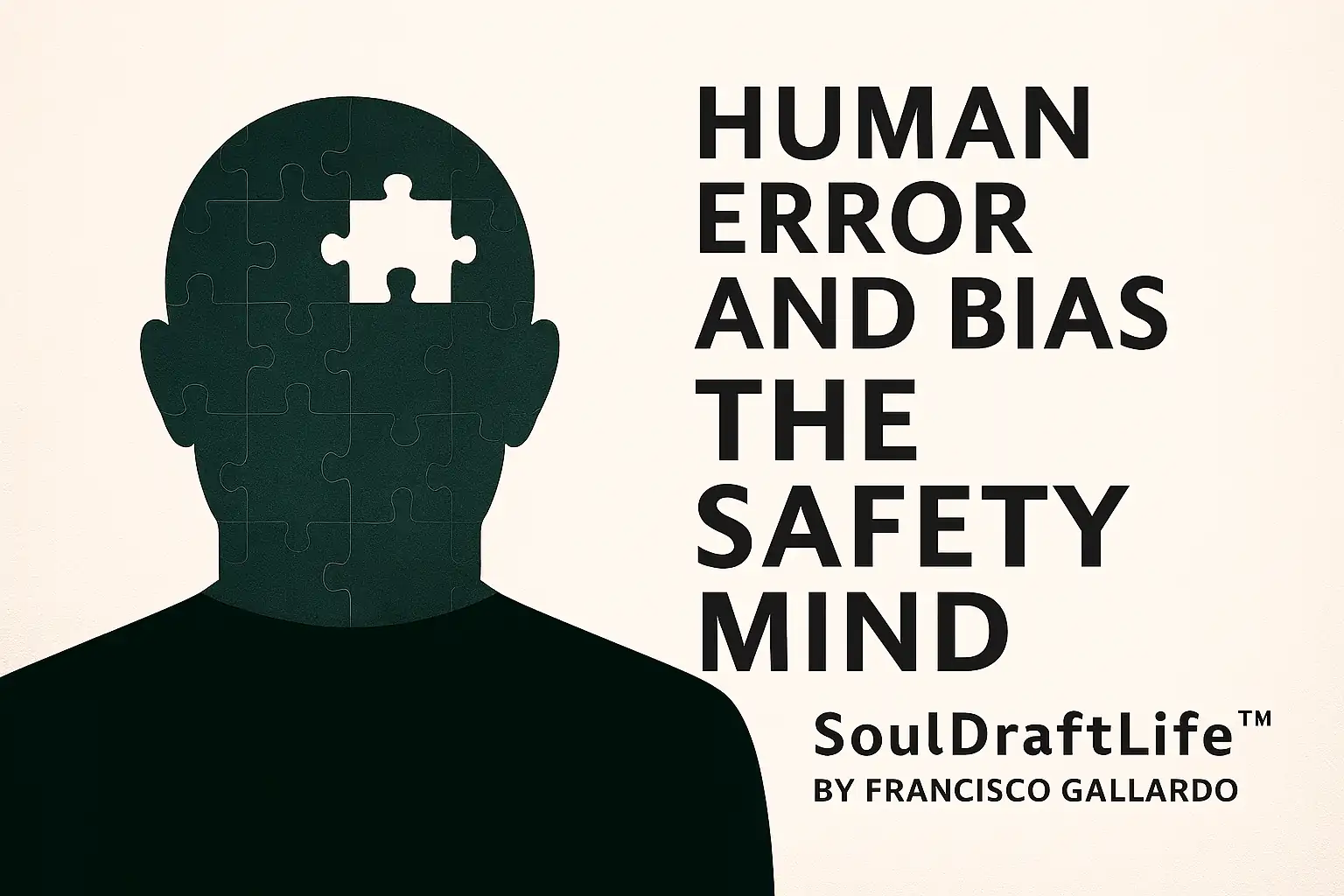
What makes the error dangerous is not its presence, but its invisibility. Bias hides it in plain sight. We confirm what we already believe. We explain the past as if it had always been obvious. We normalize what should never have been normal. Bias does not shout; it whispers. And in that whisper, errors become culture.
How Error and Bias Converge
- A checklist was skipped because “we’ve never had a problem.”
- A warning was dismissed because “it’s always there.”
- A near miss was ignored because “this is insignificant.”
This is how error and bias meet inside a system. Not as isolated events, but as habits that drift until they feel like truth.
The Safety Mind Response
It is not to punish mistakes, but to expect them. It is not to deny bias but to name it. It is to design procedures that assume slips and lapses will happen. It is to protect those who speak up so the truth can surface before the damage is done.
To see error and bias clearly is awareness renewed; the pause that restores presence and carries us to closure.
The Safety Mind Asks
- Where do I assume instead of verifying?
- Which bias most often shapes my decisions?
- Does my approach absorb errors as a lesson or a habit?
Reflection for Safety Professionals
As safety professionals, are we truly accounting for human error when we design programs, policies, and procedures?
Or are we biased, assuming errors won’t occur simply because the protocol is clearly established?
When procedures feel airtight, bias often whispers that failure is unlikely. But error is not a breach of protocol; it is part of being human.
I am convinced that to lead with safety is to expect error, not deny it.
Reflection
Before a critical task, pause for a bias check. Ask: What am I assuming? What am I ignoring? Who can challenge my view? Two minutes of reflection can prevent a lifetime of regret.
Error and bias are human. Safety is not the absence of either; it is the discipline of seeing them clearly and the courage to plan around them.
Lee este artículo en Español: Error Humano y Sesgo
Practical Note
SoulDraftLife™ uses SHOKZ bone‑conduction headsets in environments where situational awareness, communication, and hearing protection must coexist.
Bone-conduction technology enables communication and environmental awareness while wearing single or double-hearing protection, without isolating the wearer from their surroundings.
Depending on context, this includes models designed for industrial communication, training, and coordination, as well as active or lifestyle use, such as the OpenComm, OpenMeet, OpenRun Pro, OpenRun, OpenDots, and OpenFit series.
Previous Safety Moments:
SM‑1: The Safety Mind Introduction | SM‑2: What Is The SAFETY MIND? | SM‑3: The Safety Mind Disclaimer | SM‑4: The Psychology of Risk | SM-5: The Safety Moment | SM-6: When Mind Becomes Moment | SM-7: The Human Side of Safety | SM-8: The Perception of Risk | SM-9: Why We Misjudge Risk
SoulDraftLife by Francisco Gallardo – November 19, 2025
SoulDraftLife runs on Kinsta because a legacy deserves a rock‑solid foundation.