The Blind Spot of Normalization
SoulDraftLife™ | The Safety Mind | SM‑16
The Blind Spot of Normalization
The Safety Mind Responds
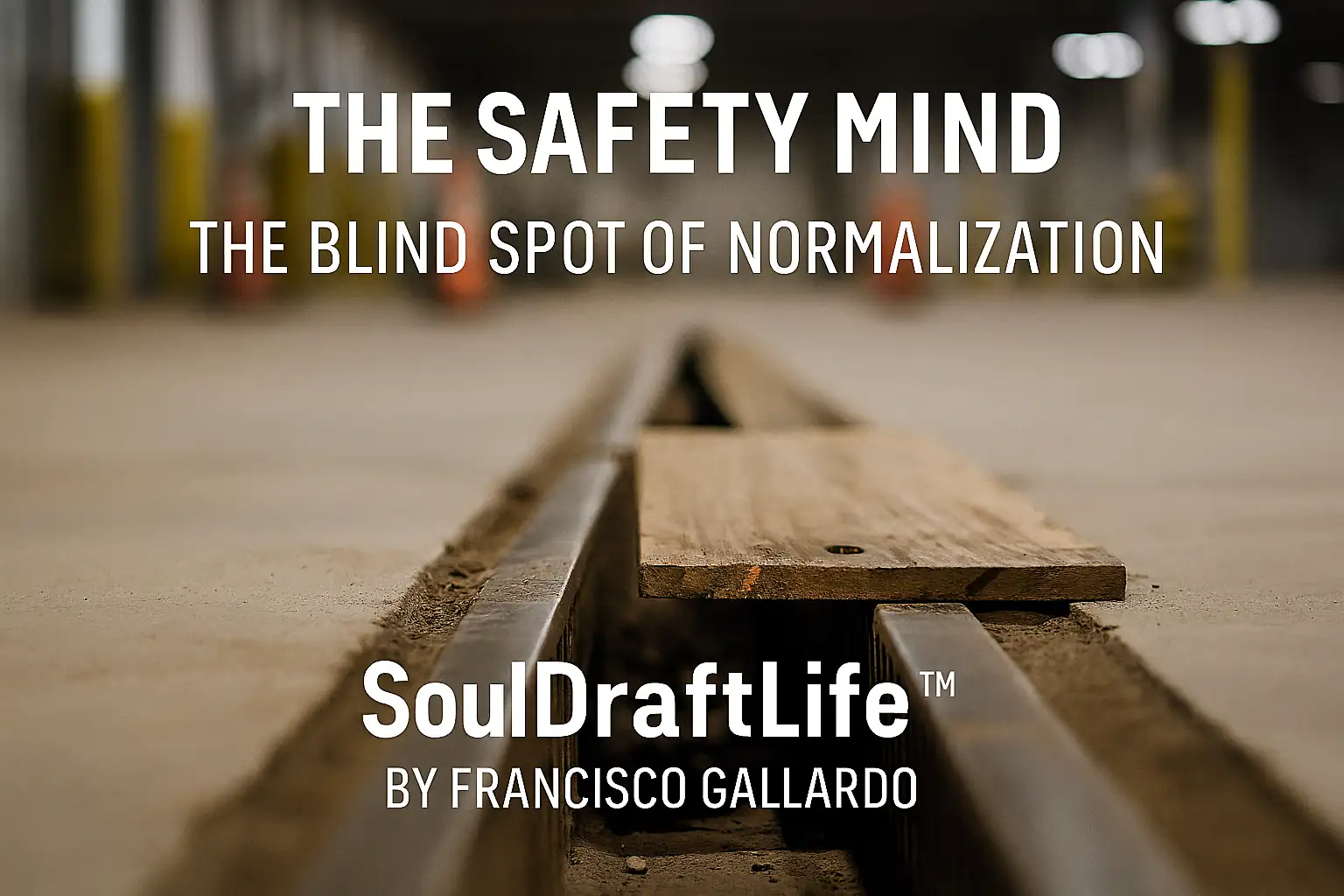
A worker steps over the same frayed cable every morning. At first, he notices it. He even thinks someone should fix that. But after a week, it blends into the floor. After a month, it disappears entirely from his awareness. The cable hasn’t changed; only his perception has.
This is how risk hides in plain sight. The most dangerous risks are not always the ones that shock us. They become ordinary. A shortcut repeated often enough stops looking like a shortcut, and a hazard seen every day stops looking like a hazard.
This is the blind spot of normalization: when familiarity disguises danger as routine. The Safety Mind warns that normalization is not resilience. It is erosion. Each unnoticed compromise chips away at awareness until the unacceptable becomes invisible.
Concrete Example
- A ladder missing one rung that “everyone knows about.”
- A guard removed “just for a minute” that never returns.
These show how normalization disguises danger.
When you slow down enough to honestly look, more blind spots begin to surface; like those abstract images that only reveal themselves once your focus shifts. The longer you hold that focus, the more the hidden picture sharpens, and suddenly you see risks that were there all along, waiting for your attention to return.
Now, noticing blind spots is only the first step. The Safety Mind insists on understanding why we normalized them in the first place, what pressures, habits, or assumptions made the abnormal feel acceptable. That clarity opens the door to real correction: communicating openly, naming the problem, and implementing the actions needed to keep awareness alive.
Contrast
- Resilience = adapting while keeping awareness alive.
- Normalization = adapting by erasing awareness.
This sharpens the distinction.
Cultural Layer
- How teams silently agree to ignore the abnormal.
- How silence itself becomes the signal of acceptance.
Think about it
We stop seeing what doesn’t change; the mind edits it out, mistaking repetition for safety. In truth, this false comfort breeds what I call accidental safety techniques: habits that feel protective but quietly raise the odds of failure. Only a fresh, awake Safety Mind can break that spell.
The Safety Mind Asks
- What risks have become so familiar that you no longer notice them?
- When was the last time you challenged a “normal” practice?
- Do your safety programs reward awareness, or do they quietly reward complacency?
Reflection
Think of one routine in your daily work that feels automatic.
- What risk hides inside that routine?
- What would it take to see it again with fresh eyes?
Normalization isn’t a failure of intelligence; it’s a failure of memory.
We forget the moment we decided to stop caring.
The Safety Mind brings that moment back into view.
The Safety Mind Insists
Normalization is not safety. It is the slow fading of awareness. Proper safety is the discipline of seeing clearly, even when the risk has been there all along.
Lee este artículo en Español: La ceguera de la normalización
Practical Note
SoulDraftLife™ uses SHOKZ bone‑conduction headsets in environments where situational awareness, communication, and hearing protection must coexist.
Bone-conduction technology enables communication and environmental awareness while wearing single or double-hearing protection, without isolating the wearer from their surroundings.
Depending on context, this includes models designed for industrial communication, training, and coordination, as well as active or lifestyle use, such as the OpenComm, OpenMeet, OpenRun Pro, OpenRun, OpenDots, and OpenFit series.
Previous Safety Moments:
SM‑1: The Safety Mind Introduction | SM‑2: What Is The SAFETY MIND? | SM‑3: The Safety Mind Disclaimer | SM‑4: The Psychology of Risk | SM-5: The Safety Moment | SM-6: When Mind Becomes Moment | SM-7: The Human Side of Safety | SM-8: The Perception of Risk | SM-9: Why We Misjudge Risk | SM-10: Human Error and Bias | SM-11: Group Dynamics and Silence | SM-12: Fatigue, Distraction, and Focus | SM-13: The Weight of Routine | SM-14: Frameworks as Scaffolding, Not Cages | SM-15: The Illusion of Control
SoulDraftLife by Francisco Gallardo – December 31, 2025
SoulDraftLife runs on Kinsta because a legacy deserves a rock‑solid foundation.