The Perception of Risk
SoulDraftLife™ | The Safety Mind | SM‑8
The Perception of Risk
When Familiarity Becomes Blindness
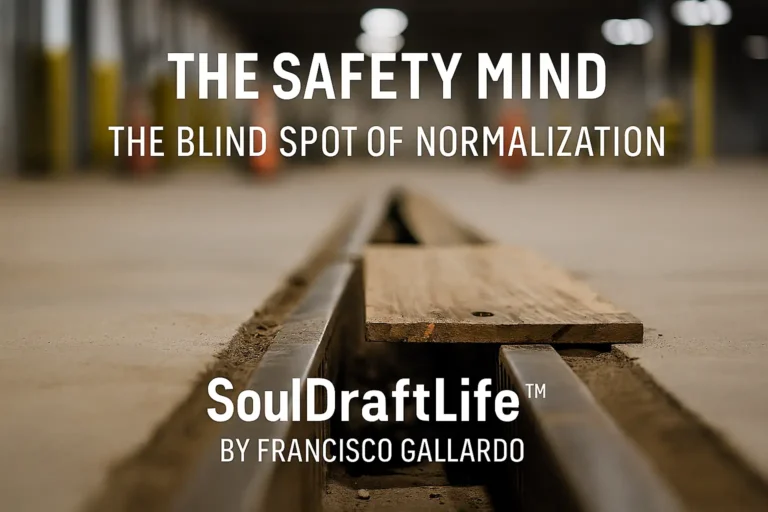
The size of the hazard does not always measure risk. More often, it is shaped by the way we see or fail to see the ordinary. A machine that has run for years without incident. A shortcut repeated until it feels like the rule. A warning sign that fades into the background because it has been there too long.
The danger is not only in the object, but in the perception that it is harmless.
The Illusion of Control
Experience can sharpen awareness, but it can also dull it. The more familiar we become with a task, the more likely we are to underestimate its risks. Confidence convinces us that skill alone will protect us. Repetition convinces us that nothing will change. Yet accidents often occur not because the hazard was invisible, but because our perception of it was distorted by routine.
Culture Shapes What We See
Perception is not individual; it is collective. If a team accepts shortcuts as usual, then risk becomes invisible to everyone. If silence is the response to unsafe behavior, then silence itself becomes a signal: this is acceptable.
Over time, culture reshapes perception until danger feels ordinary.
Reframing Awareness
The Safety Mind requires us to question what feels familiar. To pause before assuming that routine equals safe. To listen when silence should be broken. To recognize that perception is fragile, and that awareness must be renewed daily. Risk is not only about what exists in the environment; it is about how we choose to see it.
The Safety Mind Asks
- What risks do you underestimate because they feel familiar?
- How often do you confuse routine with safety?
- When silence falls, do you assume agreement or recognize it as a warning?
- Which risk signals do you choose not to see because they unsettle your perception?
Reflection
Perception begins with the willingness to notice what routine tries to hide. Awareness is not a checklist; it is the act of seeing each other, and the risks we carry, with fresh eyes each day.
The next time you walk into a safety conversation, pause long enough to ask what has become invisible. Notice not only what is said, but what is overlooked. Extend one more invitation, ask one more question, and create another chance for someone’s perception to surface.
Because safety is not sustained by habit, it is sustained by the renewal of awareness.
Renewing perception each day is the pause that restores presence, and presence is what carries us to closure.
Lee este artículo en Español: La Percepción del Riesgo
Practical Note
SoulDraftLife™ uses SHOKZ bone‑conduction headsets in environments where situational awareness, communication, and hearing protection must coexist.
Bone-conduction technology enables communication and environmental awareness while wearing single or double-hearing protection, without isolating the wearer from their surroundings.
Depending on context, this includes models designed for industrial communication, training, and coordination, as well as active or lifestyle use, such as the OpenComm, OpenMeet, OpenRun Pro, OpenRun, OpenDots, and OpenFit series.
Previous Safety Moments:
SM‑1: The Safety Mind Introduction | SM‑2: What Is The SAFETY MIND? | SM‑3: The Safety Mind Disclaimer | SM‑4: The Psychology of Risk | SM-5: The Safety Moment | SM-6: When Mind Becomes Moment | SM-7: The Human Side of Safety
SoulDraftLife by Francisco Gallardo – November 5, 2025
SoulDraftLife runs on Kinsta because a legacy deserves a rock‑solid foundation.