
What Is The Safety Mind?
SoulDraftLife™ | The Safety Mind | SM‑2
The Mind Before the Method
Safety is not a checklist. It is not a binder on a shelf, a laminated poster in a break room, or a compliance audit that comes once a year.
Safety is a mindset; a living, breathing lens through which we see risk, make decisions, and protect what matters most.
The Safety Mind is the architecture of that lens. It is the deliberate cultivation of awareness, judgment, and action that transforms safety from a rule to a reflex. It is not something we “switch on” when we clock in; it is a way of thinking that travels with us wherever we go, from home to a gas station, from the job site to the kitchen, and from the boardroom to the road, you name it.
The Safety Mind is boundless.
Why Start Here
Before we talk about tools, equipment, policies and procedures or protocols, we must define the mental foundation that makes them work.
Without the Safety Mind:
- Procedures become rote.
- Training fades under pressure.
- Risk hides in plain sight.
With it:
- Hazards are anticipated before they manifest.
- Decisions are made with clarity, even under stress.
- Safety becomes part of identity, not just responsibility.
Even the most safety-minded individual can be set up to fail by a flawed way of working.
The Three Lenses of the Safety Mind
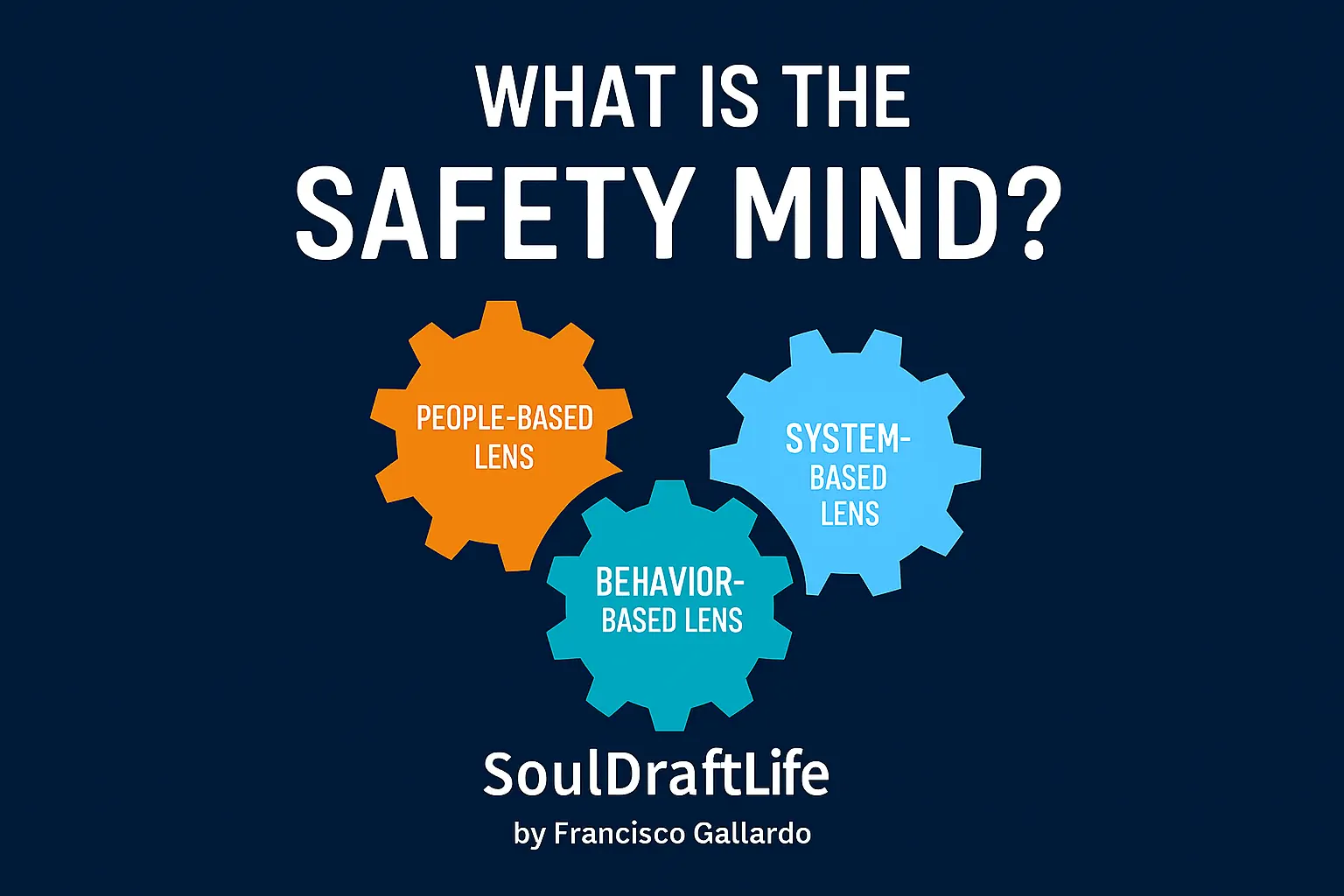
The Safety Mind is not a single viewpoint; it is a composite of three interlocking lenses. Think of them as the triangulation points that keep our perspective balanced and complete.
1. People‑Based Lens
- Focus: Human needs, limitations, and motivations.
- Key Question: How do people perceive and respond to risk?
- Why it matters: Safety is ultimately about protecting lives. Understanding human behavior, from cognitive bias to fatigue, ensures our approaches serve the people they’re meant to protect.
2. Behavior‑Based Lens
- Focus: Observable actions and habits.
- Key Question: What do people actually do, and why?
- Why it matters: Culture is shaped by what is reinforced daily. Behavior‑based safety reveals patterns, corrects unsafe habits, and strengthens the actions that sustain safety.
3. Systems‑Based Lens
- Focus: Structures, processes, and environments.
- Key Question: Does the way work is designed make the safe choice the easy choice?
- Why it matters: Even the most safety‑minded person can be set up to fail by a flawed system. Systems thinking ensures that policies and procedures, equipment, and workflows support, not sabotage safe behavior.
Where the Safety Mind Lives
The Safety Mind does not exist only in plans or procedures. It lives in moments, often quiet ones, where judgment forms before action begins.
It shows up in how we perceive risk, and why we misjudge it. In fatigue, distraction, and the slow erosion of attention. In routine, where familiarity dulls awareness. In group dynamics, where silence replaces inquiry, and responsibility diffuses.
It appears in the Hassle Factor: the small frictions that tempt us to take shortcuts. And in the Superman Effect: the quiet belief that experience alone will protect us this time.
It lives in the illusion of control, in the blind spots created by normalization, and in the way frameworks can either support thinking or quietly replace it.
The Safety Mind is present when awareness becomes a pause. When a habit is interrupted. When responsibility is carried without instruction. When compliance gives way to conviction.
These are not separate ideas. They are expressions of the same interior posture; the way safety is perceived, carried, and lived long before risk becomes visible.
From Awareness to Action
The Safety Mind is not theory; it is a practice. It moves through three stages:
- Awareness: Seeing the hazard before it becomes harm.
- Assessment: Weighing options and consequences in real time.
- Action: Choosing and executing the safest path, even when it is inconvenient.
This cycle repeats constantly, becoming second nature. Over time, it shifts from conscious effort to instinctive response.
The Cost of Not Having It
Without the Safety Mind, organizations drift into reactive safety; responding only after incidents occur.
The cost is measured not just in dollars, but in trust, morale, and human lives. In contrast, a cultivated Safety Mind creates proactive safety; where prevention is the default, and incidents are the rare exception.
Reflection
The Safety Mind is not about fear; it is about freedom.
When safety is embedded in thought, we move through the world with confidence, knowing we have the awareness, judgment, and discipline to protect ourselves and those around us.
This is not just the foundation of safety. It is the foundation of trust, leadership, and legacy.
Lee este articulo en Español: ¿Qué es la Mente Segura?
Practical Note
SoulDraftLife™ uses SHOKZ bone‑conduction headsets in environments where situational awareness, communication, and hearing protection must coexist.
Bone-conduction technology enables communication and environmental awareness while wearing single or double-hearing protection, without isolating the wearer from their surroundings.
Depending on context, this includes models designed for industrial communication, training, and coordination, as well as active or lifestyle use, such as the OpenComm, OpenMeet, OpenRun Pro, OpenRun, OpenDots, and OpenFit series.
Previous Safety Moment:
SM‑1: The Safety Mind Introduction

SoulDraftLife by Francisco Gallardo – September 19, 2025
SoulDraftLife runs on Kinsta because a legacy deserves a rock‑solid foundation.

There’s a hidden Easter egg in this post 🥚.
Tap the egg to reveal its secret message and collect all three across The Safety Mind series.
Once you have the full phrase, post it as a new comment below.
(Please also add a valuable safety message related to this post; your insight becomes part of the authored archive.)
These are the three golden eggs – The Safety Mind.
Happy Hunt – SoulDraftLife.
Safety First, Always
Stay alert, trust your instincts, and never compromise on caution, whether at work, on the road, or online. One mindful moment can prevent a lifetime of regret.
All three eggs have been found an email has been sent with the decoded message.
Correct! You did it Marco, I am very proud of you!