Silence Is Not Absence
SoulDraftLife® | The Safety Mind | SM-28
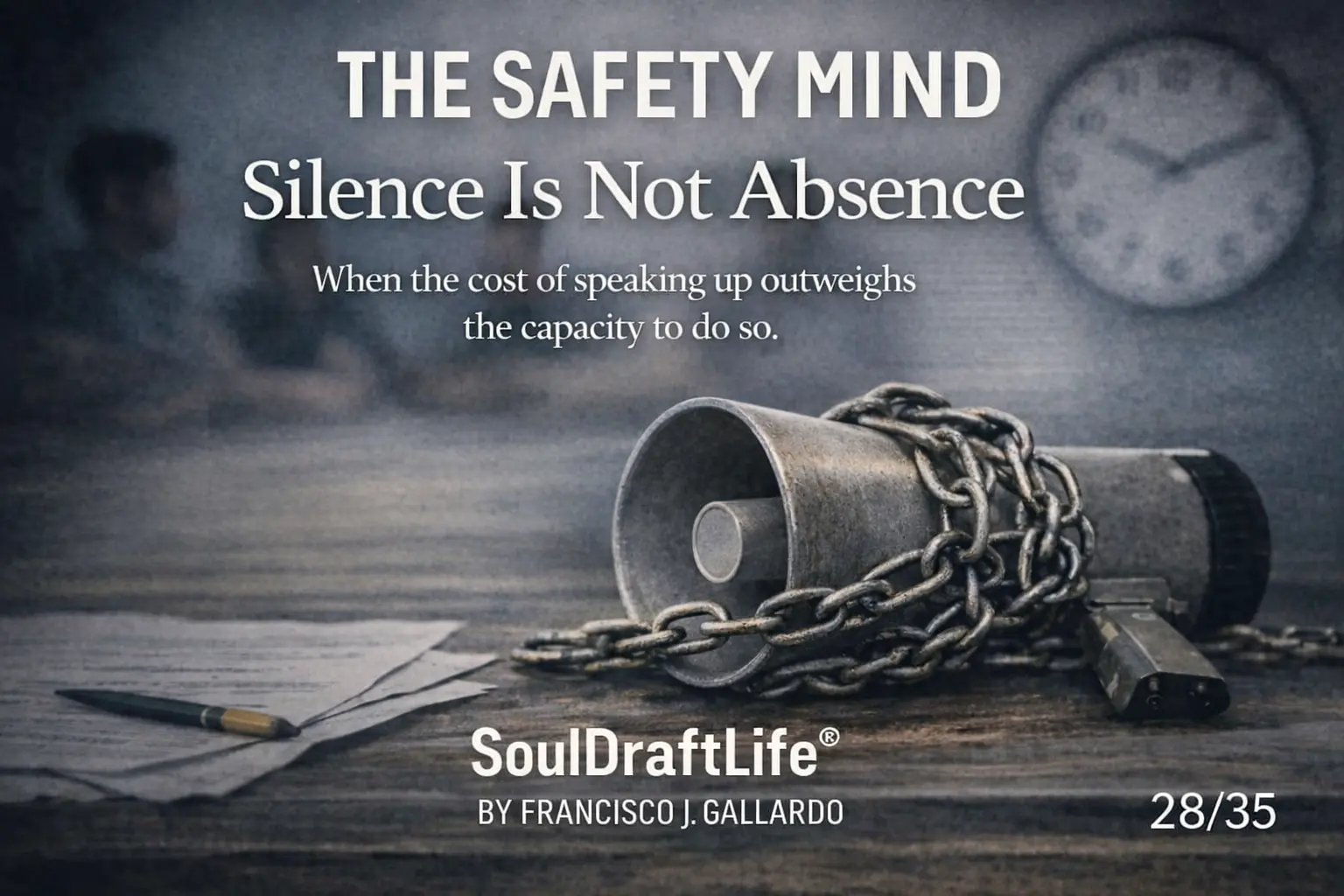
Silence Is Not Absence
Silence is often misunderstood.
In safety conversations, quiet is treated as a void, a lack of engagement, a lack of concern, a lack of awareness. When people are not speaking, the assumption is that they are not seeing, not thinking, or not invested.
But silence is rarely empty.
More often, it is compressed, shaped by conditions that still allow perception, but no longer support expression.
When Awareness Stops Moving
Silence forms when risk remains visible, but awareness no longer moves beyond the individual.
People continue to notice what feels wrong. They still recognize when something is misaligned, rushed, or fragile. What changes is not perception, but direction. Awareness turns inward instead of outward. It is held rather than shared.
Awareness is still present. It just no longer has a place to land.
This is not because people suddenly lose confidence or courage. It is because the pathway that once allowed awareness to travel has narrowed. Expression begins to feel heavier than observation. Speaking becomes an act that requires justification rather than a natural extension of noticing.
When awareness cannot move, safety becomes private.
How Silence Accumulates
Silence does not arrive as a decision. It accumulates through experience.
It grows when questions slow down momentum instead of improving it. When interruptions are tolerated but not welcomed. When concerns require explanation, defense, or repetition before they are absorbed.
Over time, people learn what the environment can carry. They learn which observations will be received and which will be deflected. They learn when attention is present and when it is merely polite.
Silence is not withdrawal. It is calibration.
People adjust their expression to match what the moment can absorb without friction. What disappears is not awareness, but the expectation that awareness will land somewhere useful.
Why Quiet Work Is Misread
This is why silence is dangerous.
Not because nothing is happening, but because everything is happening quietly.
Risk is still being managed, but internally. Judgment becomes private. Vigilance retreats into individuals rather than circulating through the group. The system continues to function, but without shared awareness to correct, challenge, or recalibrate it.
From the outside, quiet can look like stability. Work continues. Output remains steady. There is no visible resistance.
But quiet environments are often mistaken for healthy ones.
What is missing is not compliance, but conversation. Safety has not disappeared; it has lost its ability to move.
Silence as an Early Signal
Silence appears early.
Before rules were broken. Before the metrics shift. Before incidents occur.
When voices fade, it is not because people have stopped caring. It is because the cost of expression has begun to outweigh what the moment can absorb. Speaking no longer feels like a contribution; it feels like friction.
The question is not why aren’t they speaking? The question is what has made speaking feel heavier than continuing?
Silence is not the absence of concern. It is a concern that has learned to stay contained.
The Safety Mind Asks
- Where has silence become familiar rather than noticeable?
- What risks are still being seen but no longer shared?
- When did speaking begin to feel like an interruption instead of participation?
- What conditions have taught people to manage risk privately rather than collectively?
Reflection
I do not see silence as disengagement. I see it as information that no longer has a path.
When people go quietly, it is rarely because awareness has disappeared. More often, it is because awareness has nowhere to go without cost. Over time, vigilance becomes internal, judgment becomes private, and safety loses its ability to circulate through the organization.
Silence is not absence. It is presence without permission.
Safety does not fail when people stop speaking. It fails when awareness can no longer move beyond the individual. And when silence becomes familiar, it is telling us something important about what the system can no longer carry.
Lee este artículo en Español: El Silencio No Es Ausencia
Practical Note
SoulDraftLife™ uses SHOKZ bone‑conduction headsets in environments where situational awareness, communication, and hearing protection must coexist.
Bone-conduction technology enables communication and environmental awareness while wearing single or double-hearing protection, without isolating the wearer from their surroundings.
Depending on context, this includes models designed for industrial communication, training, and coordination, as well as active or lifestyle use, such as the OpenComm, OpenMeet, OpenRun Pro, OpenRun, OpenDots, and OpenFit series.
Previous Safety Moments:
SM‑1: The Safety Mind Introduction | SM‑2: What Is The SAFETY MIND? | SM‑3: The Safety Mind Disclaimer | SM‑4: The Psychology of Risk | SM-5: The Safety Moment | SM-6: When Mind Becomes Moment | SM-7: The Human Side of Safety | SM-8: The Perception of Risk | SM-9: Why We Misjudge Risk | SM-10: Human Error and Bias | SM-11: Group Dynamics and Silence | SM-12: Fatigue, Distraction, and Focus | SM-13: The Weight of Routine | SM-14: Frameworks as Scaffolding, Not Cages | SM-15: The Illusion of Control | SM-16: The Blind Spot of Normalization | SM-17: Rituals as Memory | SM-18: The OARC Lens | SM-19: From Compliance to Conviction | SM-20: The Weight of Example | SM-21: Trust as the Currency of Safety | SM-22: Language That Shapes Culture | SM-23: The Courage to Stop Work | SM-24: Ownership as Legacy | SM-25: Pressure Changes the Terrain | SM-26: When Knowing Is No Longer Enough | SM-27: Safety Requires Margin
SoulDraftLife by Francisco Gallardo – March 25, 2026
SoulDraftLife runs on Kinsta because a legacy deserves a rock‑solid foundation