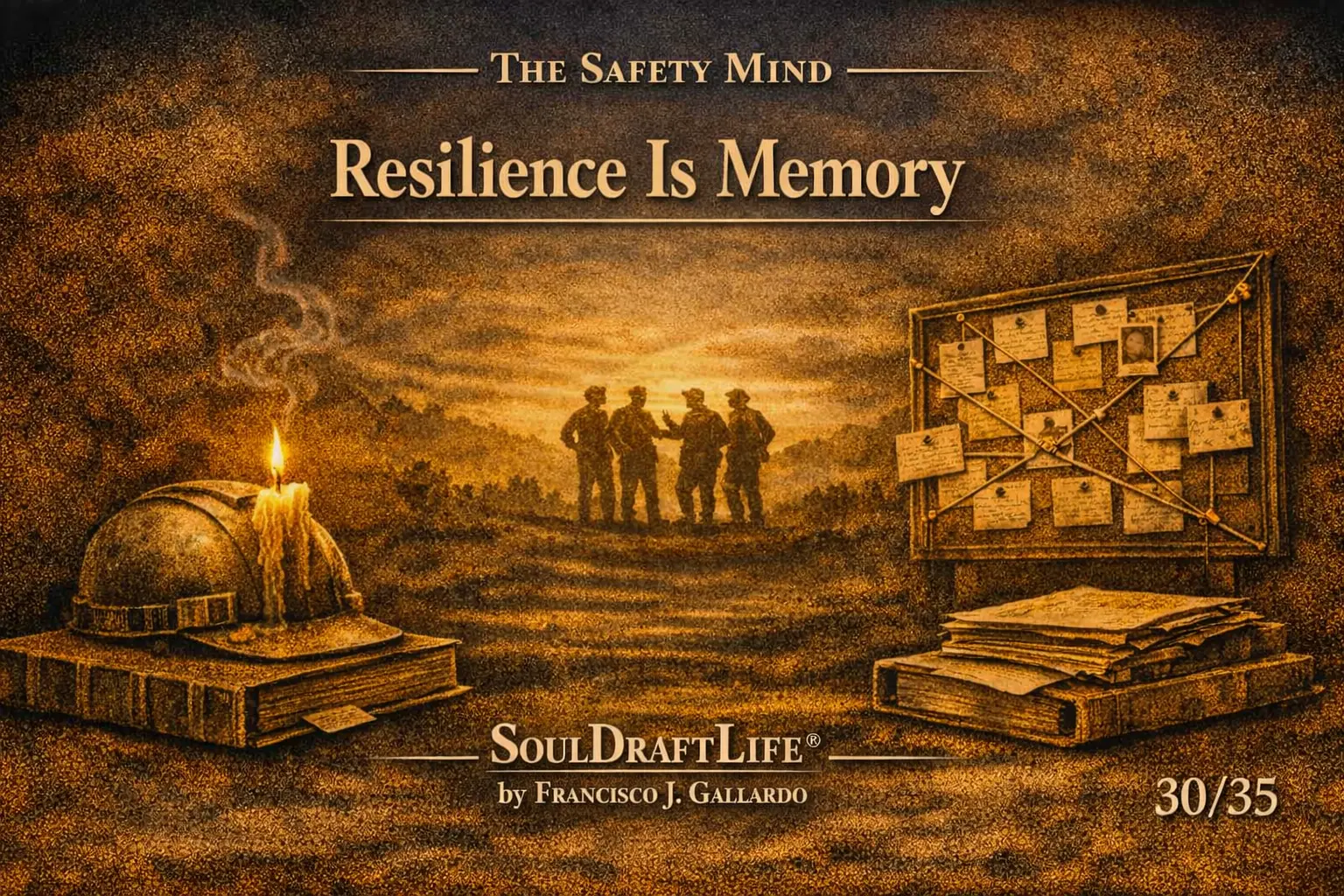
Resilience Is Memory
SoulDraftLife® | The Safety Mind | SM-30
Resilience Is Memory
Resilience is often described as endurance.
The ability to absorb pressure, adapt quickly, and keep going. In safety, this framing quietly shifts responsibility onto individuals, asking them to carry strain longer, recover faster, and remain vigilant under conditions that continue to erode capacity.
The Safety Mind understands resilience differently.
Resilience is not toughness. It is memory.
Why Individual Resilience Always Fails Eventually
No individual endures indefinitely.
People tire. We rotate. We leave. We forget. Even the most capable professionals cannot carry vigilance alone across time, fatigue, and change. When safety depends on personal endurance, it becomes fragile the moment conditions intensify or people change.
This is not a failure of character. It is a limit of being human.
Safety that survives pressure does so not because individuals are strong, but because experience is preserved beyond the individual.
Memory as the Carrier of Safety
Memory allows safety to persist when attention thins.
It holds lessons learned under strain. It preserves context when urgency returns. It keeps past failures present enough to influence present judgment without requiring people to relearn them through harm.
This memory does not live primarily in documents.
It lives in stories that are told. In pauses that are ritualized. In reflections that are shared rather than archived.
When memory is active, safety knowledge remains accessible even when conditions deteriorate. When memory fades, organizations repeat what they already know, not because they are careless, but because knowledge no longer lives where decisions are made.
Why Cultures Repeat the Same Mistakes
When resilience is framed as toughness, failure becomes personal.
When resilience is framed as memory, repetition becomes understandable.
Cultures repeat mistakes when experience is not carried forward. When lessons are recorded but not remembered. When reflection is treated as optional rather than essential. When turnover erases context faster than it can be rebuilt.
This repetition is not ignorance. It is amnesia.
Resilient cultures are not those that avoid failure entirely, but those that remember what matters when pressure returns.
Shared Vigilance Is the Original Safety Practice
Long before safety was formalized, vigilance was collective.
Awareness moved through groups. Someone noticed while others worked. Someone remembered while others rested. Safety survived not because individuals were constantly alert, but because memory was distributed.
Modern organizations often centralize safety into roles, programs, and functions. These structures provide coordination, but they cannot replace shared vigilance. No role can be present everywhere judgment is required.
Memory restores what structure alone cannot.
It allows awareness to circulate again.
The Safety Mind Asks
- What lessons are being learned but not carried forward?
- Where does experience live once the moment passes?
- What stories are told when pressure returns?
- How is memory preserved beyond the people who lived it?
The Safety Mind Insists
Resilience must be designed, not demanded.
Safety cannot rely on individual endurance to compensate for structural strain. When resilience is treated as toughness, people are consumed. When it is treated as memory, safety endures.
Memory is what allows safety to survive fatigue, turnover, and change. It is how vigilance persists when individuals cannot.
Reflection
I do not see resilience as the ability to keep going.
I see it as the ability to remember.
When organizations forget, they repeat. When they remember, they adapt without breaking. Safety does not endure because people are strong enough to carry it alone. It endures because experience is held in common and carried forward deliberately.
Resilience is not recovery. It is continuity.
And continuity is what allows safety to survive pressure without asking people to become something other than human.
Lee este artículo en Español: La Resiliencia es Memoria
Practical Note
SoulDraftLife™ uses SHOKZ OpenRun Pro 2 in environments where situational awareness and hearing protection must coexist.
Bone-conduction technology allows communication and awareness while wearing single- or double-hearing protection, without isolating the wearer from their surroundings.
Previous Safety Moments:
SM‑1: The Safety Mind Introduction | SM‑2: What Is The SAFETY MIND? | SM‑3: The Safety Mind Disclaimer | SM‑4: The Psychology of Risk | SM-5: The Safety Moment | SM-6: When Mind Becomes Moment | SM-7: The Human Side of Safety | SM-8: The Perception of Risk | SM-9: Why We Misjudge Risk | SM-10: Human Error and Bias | SM-11: Group Dynamics and Silence | SM-12: Fatigue, Distraction, and Focus | SM-13: The Weight of Routine | SM-14: Frameworks as Scaffolding, Not Cages | SM-15: The Illusion of Control | SM-16: The Blind Spot of Normalization | SM-17: Rituals as Memory | SM-18: The OARC Lens | SM-19: From Compliance to Conviction | SM-20: The Weight of Example | SM-21: Trust as the Currency of Safety | SM-22: Language That Shapes Culture | SM-23: The Courage to Stop Work | SM-24: Ownership as Legacy | SM-25: Pressure Changes the Terrain | SM-26: When Knowing Is No Longer Enough | SM-27: Safety Requires Margin | SM-28: Silence Is Not Absence | SM-29: Belonging Is the Permission to Intervene
SoulDraftLife by Francisco Gallardo – April 8, 2026
SoulDraftLife runs on Kinsta because a legacy deserves a rock‑solid foundation