Belonging Is the Permission to Intervene
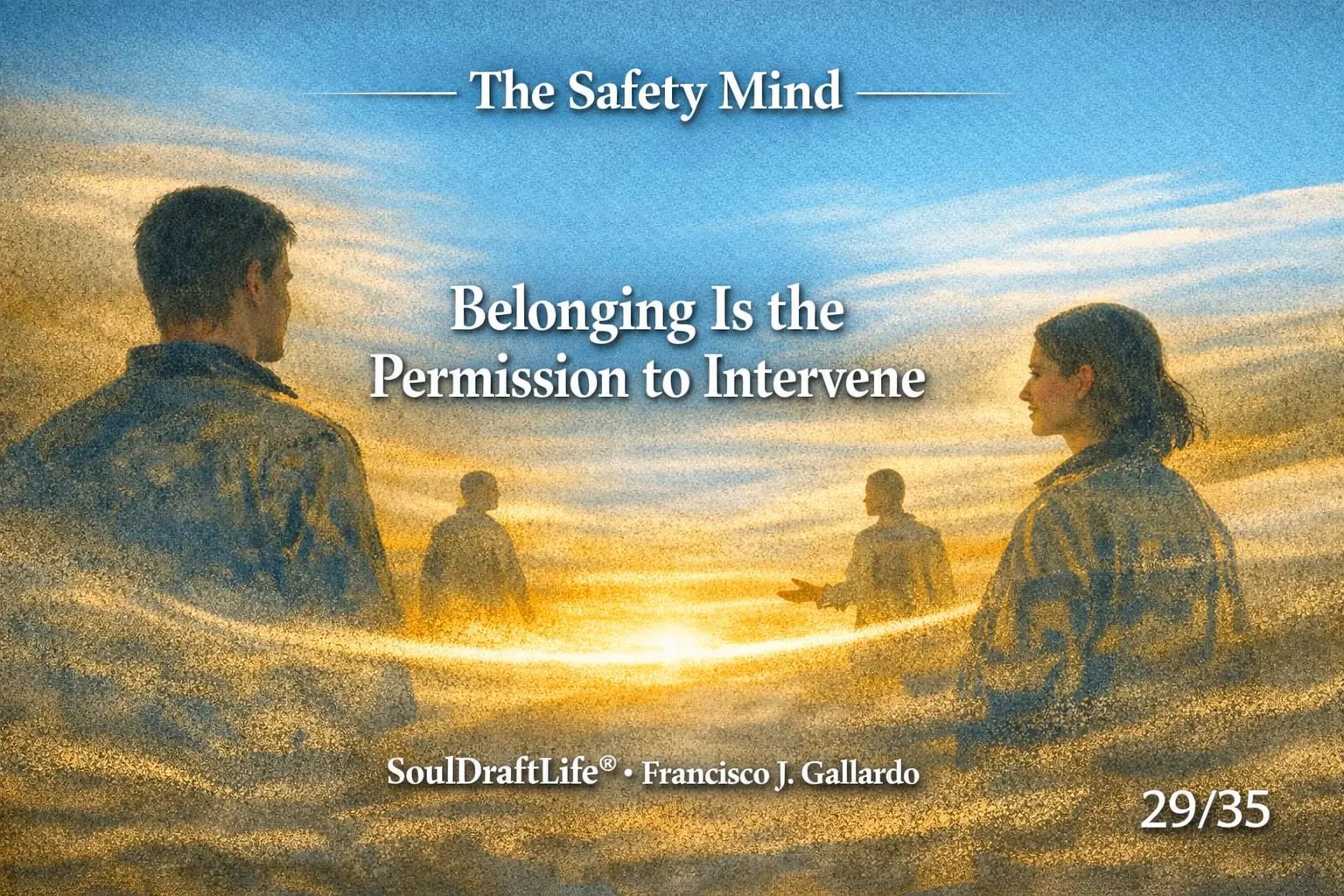
SoulDraftLife® | The Safety Mind | SM-29
Belonging Is the Permission to Intervene
Belonging is rarely named in safety, yet it determines whether awareness can move.
People do not intervene simply because they see risk. They intervene when the environment allows awareness to leave the individual and enter the collective. When that permission is absent, awareness remains private, even when it is clear, accurate, and urgent.
The Safety Mind recognizes belonging not as emotion, but as infrastructure.
When Awareness Stalls
Awareness does not fail under pressure. It stalls.
People continue to notice what feels wrong. They recognize misalignment, fatigue, and fragility. What changes is not perception, but movement. Awareness no longer travels outward because the conditions that once supported expression have thinned.
Intervention begins to feel heavier than observation. Speaking requires calculation. Silence becomes safer than interruption.
This is not fear. It is assessment.
The Safety Mind understands this moment as a signal that the environment’s relational capacity has narrowed, not that awareness has disappeared.
Belonging Is Not Comfort
Belonging is often confused with harmony.
Comfortable environments feel smooth. Work flows. Conflict is minimal. But comfort alone does not protect safety. When comfort becomes the goal, interruption becomes costly.
Belonging functions differently.
Belonging does not remove friction. It makes friction survivable. It allows questions to be asked without isolation, pauses to occur without penalty, and concerns to surface without threatening identity.
Where belonging exists, people do not ask whether they are allowed to speak. The permission is already present.
The Safety Mind does not seek ease. It seeks conditions that can absorb interruption without collapse.
Intervention Is a Relational Act
In practice, intervention is rarely procedural.
It does not occur because a rule demands it. It occurs because a relationship can carry it. When people feel connected, interruption is absorbed by the relationship rather than resisted by imposed structure.
Without that relational foundation, even well-designed procedures remain dormant. People hesitate not because they lack knowledge, but because they lack connection.
Belonging turns awareness into action by removing the social cost of speaking.
A Small Moment That Explains Everything
A task is already underway. The plan is sound. The procedure is being followed.
Someone notices a subtle shift: fatigue, a rushed handoff, a step taken slightly out of sequence. Nothing that violates a rule. Nothing that demands authority.
They hesitate.
Not because they are unsure, but because speaking would interrupt momentum. It would slow people who already want to finish. It would require explanation.
In one environment, they stay quiet.
In another, they speak briefly and calmly because they know the relationship can handle it. The pause holds. The adjustment is made. Work continues.
The difference is not courage. It is belonging.
Why Safety Collapses When People Feel Alone
Isolation traps awareness.
When people feel alone, responsibility narrows. Risk is seen but not shared. Judgment becomes private. Over time, safety collapses not through defiance, but through fragmentation.
Belonging restores collective vigilance. It allows awareness to circulate, intervention to occur, and responsibility to be shared. Without it, safety becomes an individual burden, and eventually, an unsustainable one.
This is why belonging sits at the structural center of safety under strain.
The Safety Mind Asks
- Where does awareness still exist but no longer move?
- When did speaking begin to feel like an interruption instead of participation?
- Who carries risk privately because the connection no longer supports expression?
- What conditions determine whether intervention is absorbed or resisted?
The Safety Mind Insists
Belonging must be designed, not assumed.
Safety cannot rely on courage alone. When intervention requires bravery, the conditions have already failed to provide permission. Belonging removes the need for heroics by making interruptions ordinary.
Without belonging, awareness remains trapped. With it, safety becomes collective again.
Reflection
I see belonging as the quiet condition that determines whether safety can still function under pressure.
When people belong, they do not need to calculate whether speaking is worth the cost. They intervene because the relationship can carry it. When belonging erodes, awareness does not disappear; it becomes private. Silence follows not from apathy, but from constraint.
Safety does not fail when people stop caring. It fails when the environment no longer allows care to move.
Belonging is not soft. It is strength. It is the permission that allows awareness to become action before silence becomes the norm.
Lee este artículo en Español: Pertenecer Es El Permiso Para Intervenir
Practical Note
SoulDraftLife™ uses SHOKZ OpenRun Pro 2 in environments where situational awareness and hearing protection must coexist.
Bone-conduction technology allows communication and awareness while wearing single- or double-hearing protection, without isolating the wearer from their surroundings.
Previous Safety Moments:
SM‑1: The Safety Mind Introduction | SM‑2: What Is The SAFETY MIND? | SM‑3: The Safety Mind Disclaimer | SM‑4: The Psychology of Risk | SM-5: The Safety Moment | SM-6: When Mind Becomes Moment | SM-7: The Human Side of Safety | SM-8: The Perception of Risk | SM-9: Why We Misjudge Risk | SM-10: Human Error and Bias | SM-11: Group Dynamics and Silence | SM-12: Fatigue, Distraction, and Focus | SM-13: The Weight of Routine | SM-14: Frameworks as Scaffolding, Not Cages | SM-15: The Illusion of Control | SM-16: The Blind Spot of Normalization | SM-17: Rituals as Memory | SM-18: The OARC Lens | SM-19: From Compliance to Conviction | SM-20: The Weight of Example | SM-21: Trust as the Currency of Safety | SM-22: Language That Shapes Culture | SM-23: The Courage to Stop Work | SM-24: Ownership as Legacy | SM-25: Pressure Changes the Terrain | SM-26: When Knowing Is No Longer Enough | SM-27: Safety Requires Margin | SM-28: Silence Is Not Absence
SoulDraftLife by Francisco Gallardo – April 1, 2026
SoulDraftLife runs on Kinsta because a legacy deserves a rock‑solid foundation